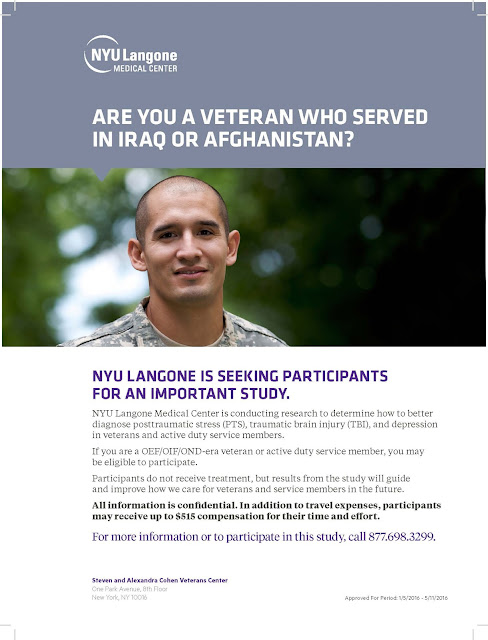
Steven. A. Cohen Military Family Clinic at NYU Langone Medical Center
Free Clinics Aim To Fill VA’s Shortfalls In Mental Health
Elenilson
Franco, who suffers from post-traumatic stress disorder, depression and
anxiety, first sought mental health care from the Department of
Veterans Affairs nearly four years ago.
He is still waiting. The VA lost his original paperwork and hasn’t yet approved a new application, he said.
“It’s
frustrating,” lamented Franco, 46, who served in Iraq as a U.S. Marine.
“I am a veteran. The VA is supposed to be there for me.”
Over
the past three years, the sprawling VA system has come under fire from
Congress and the media because veterans were waiting too long to see a
doctor. Mental health appointments have been particularly difficult, and
that can be dangerous for veterans. Studies show up to 20 percent of
soldiers returning from battle in Iraq and Afghanistan suffer from
post-traumatic stress disorder.
The
much-needed new treatment is underwritten by an unlikely benefactor:
Steven A. Cohen, the former head of a hedge fund that pleaded guilty to
insider trading charges in 2013. His $13 billion fortune puts him among
the 100 wealthiest individuals in the world, according to Forbes
magazine.
Cohen
said the catalyst for the clinics was his son, Robert, who served with
the U.S. Marine Corps in Afghanistan. He said his son didn’t need
counseling when he returned, but many of his friends did.
“I got lucky,” Cohen said. “My son came back in great shape, but not everyone is that fortunate.”
Cohen
got involved with veterans’ mental health issues in 2011 through the
Robin Hood Foundation, an anti-poverty organization. Then he began
supporting the NYU Military Family Clinic. Now, he is investing $275
million nationally in the clinics and plans to open roughly 20 more over
the next five years. The goal of the clinics is to provide confidential
mental health services, free of charge, for veterans like Franco.
“Veterans
are suffering,” Cohen said in a written response to questions. “They
went overseas and paid an extraordinary debt that we need to repay. The
goal of my network is to help pay back that debt and get veterans back
into society in a functioning way.”
The
clinics, part of the nonprofit Cohen Veterans Network, are intended
primarily for those who have served in the military during the post-September 11 era, though they are open to all veterans. Cohen said he is putting them in areas of high need.
“There’s
a large population of veterans who need mental health services,” said
Terri Tanielian, a senior behavioral scientist at Santa Monica-based
RAND Corporation. “This provides them with another option. … The clinics
certainly add to our nation’s capacity.”
Franco,
who lives in Huntington Park, Calif., said that he was able initially
to find help through a local nonprofit, but he plans to visit the Cohen
clinic in L.A. “very soon.”
In
addition to Los Angeles, Cohen’s network also operates clinics in New
York City, San Antonio, Philadelphia and Addison, Texas – a suburb of
Dallas. They care for veterans regardless of how long they served or how
they were discharged. The clinics also serve veterans’ family members.
The outpatient centers treat a wide range of mental health disorders and
help veterans make the transition back to civilian life. Cohen is also
funding a nonprofit research organization, Cohens Veterans Bioscience, that will seek to develop tests and medications for PTSD and traumatic brain injuries.
Cohen
is the CEO of Point72 Asset Management in Stamford, Connecticut, and
formerly headed SAC Capital Advisors, which pleaded guilty in 2013 to
insider trading charges. Cohen himself is temporarily barred from supervising funds that manage outside money – part of an agreement with the Securities and Exchange Commission.
In
addition to Los Angeles, Cohen’s network also operates clinics in four
other cities around the U.S. They care for veterans regardless of how
long they served or how they were discharged and also serve veterans’
family members. (Photo courtesy the University of Southern California)
The
new network of clinics combats “the persistent delays and the
persistent lack of access that our service members and our families have
experienced,” said Marilyn L. Flynn, the dean of the University of
Southern California School of Social Work. The Cohen clinic in Los
Angeles operates in partnership with the School of Social Work and USC’s
Keck School of Medicine.
“It’s
not just lack of access,” Flynn said during the grand opening of the
Los Angeles clinic last month. “In some cases, it’s exclusion.”
One
study by the VA found that about 30 percent of Iraq and Afghanistan
veterans treated at Veterans Affairs hospitals and clinics had PTSD. Yet
only about half of veterans with PTSD are receiving care for their
condition, RAND’s Tanielian said. Barriers to care include a shortage of
mental health providers and perceptions that seeking care is a sign of
weakness or could hurt their career.
Some
younger veterans prefer not to use VA facilities for health care,
either because of location, concerns about confidentiality or a desire
not to take services away from older veterans, Tanielian said.
And
many veterans seek care outside the VA because they don’t qualify for
the government-funded services, said Milo Peinemann, chief strategy
officer at New Directions for Veterans, a Los Angeles nonprofit.
The
fact the Cohen clinics don’t have strict eligibility rules will enable
them to reach an entire population of veterans who are currently being
underserved, Peinemann said.
Over
the past decade, community organizations have expanded physical and
mental health care access for veterans. The Warrior Care Network, for
example, is trying to fill gaps in government care through a partnership
with four academic medical centers across the U.S.
Angel
Ewers, 41, her husband, and their teenage children are being treated at
the Cohen clinic in San Antonio. Ewers said her husband, who served in
the Army, Air Force and the National Guard, tried to commit suicide
nearly three years ago. Since then, he has been in and out of
psychiatric hospitals and seen numerous providers.
He
didn’t have a good experience at the VA, Ewers said. “He felt like it
was more, ‘Get him in, get him out,’” she said. “He was a number.”
Not having to pay for care at the Cohen clinic is a “financial relief”, she said.
When
possible, the clinics will bill insurance, said Anthony Hassan,
president and CEO of the Cohen Veterans Network. But he noted that not
all veterans and family members want their insurance companies to know
they are seeking mental health treatment.
Providers
across the network will strive to provide care that is based on proven
best practices, said Ian Chuang, chief medical officer for Netsmart, a
technology company that is tracking outcomes and supporting research at
the Cohen clinics.
“The
Cohen veteran clinics are trying to push the boundaries and say, ‘We
need to do better,’” Chuang said. “We want to be part of figuring out
what better means.”
The
clinics are staffed by social workers, psychologists and students,
including veterans. At the Los Angeles clinic, providers offer
individual counseling, substance abuse treatment, and psychiatric
services. Staff members also connect families with other services,
including transportation, housing and child care.
The clinic plans to open satellite centers around Los Angeles County and to collaborate with existing providers.
Partnering
with a university and having the flexibility of private funds makes the
L.A. clinic uniquely qualified to provide the best scientific treatment
as it evolves, said Marvin Southard, the clinic’s CEO and former mental
health director for L.A. County. “And it’s constantly evolving,” he
said.
Tags: Clinics, Veterans' Health